Eanna/E-anna, or 𒂍𒀭𒈾 in Sumerian, literally means “House of Heaven”, with:
- E/𒂍 | meaning house or temple,
- An/𒀭 | meaning heaven, or alternatively, referring to the Sky God An, and
- Na/𒈾 | meaning “of”, or used to show possession.
Traditionally, Eanna was considered the residence of the Goddess Inanna, and was also referred to as the “Temple of Inanna”.

According to Sumerian mythology, the original Temple of Eanna was established by Enmerkar, a legendary king of Kulaba.1
In the myth of Enmerkar and the Lord of Aratta, King Enmerkar wishes to build and beautify the Temple of Eanna for its tutelary deity, the Goddess Inanna. He seeks lapis lazuli, silver, and other precious materials that are only available in the land of Aratta, whose king is not named.
Although the Lord of Aratta is also crowned in Inanna’s name, Inanna favours Enmerkar’s construction of Her temple and withdraws Her support from Aratta for Kulaba.
Enmerkar sends a messenger to Aratta, demanding that he submit to Kulaba and provide the desired materials for Inanna’s temple. The Lord of Attar refuses, and sends the messenger back.
The two kings send the messenger back and forth with their ever-growing messages, to the point where they get so long that the king of Kulaba invents writing on a clay tablet because the messenger was unable to remember his lengthy message.
In the end, Inanna’s divine favour on Enmerkar and Kulaba is proven, and the Lord of Aratta concedes and sends the required material for the Temple of Eanna.
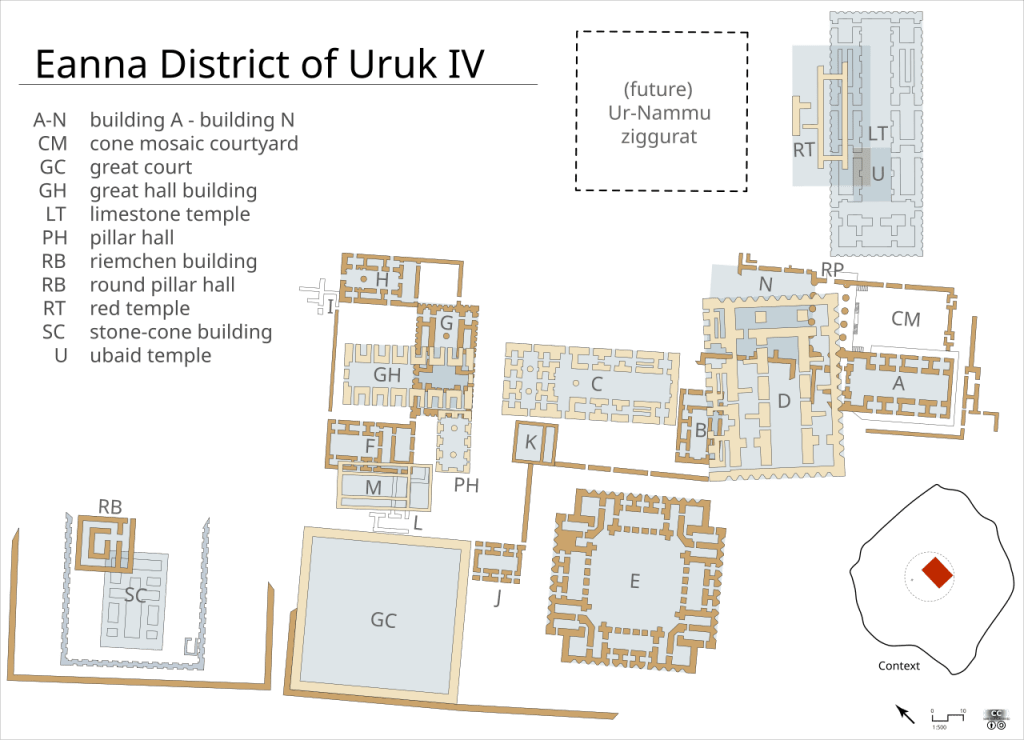
According to archaeological evidence, the Eanna District2 was rebuilt over thousands of years. It was originally built during the Uruk period (4000 to 3100 BCE, or between 5,000 to 6,000 years ago) in different stages.
In the Uruk IV period (3400 to 3200BCE), the district consisted of mudbrick buildings; by the Uruk III period (3200 to 3000BCE), large temple platforms and mosaics are believed to have been constructed.
By the Early Dynastic I to III periods (2900 to 2350BCE), the temple had already been rebuilt multiple times and become a political and cultural hub.
By the Akkadian and Neo-Sumerian periods (2300 to 2000BCE), Eanna had been restored by a number of Akkadian and Sumerian kings, such as Rimush, the son of Sargon of Akkad, and Ur-Nammu, a Sumerian king who rose to power after centuries of Akkadian and Gutian subjugation.
Finally, by the time of the Seleucid period between the 4th century and 2nd century (or 2400 to 2100 years ago), Eanna had begun to decline as both a religious and political centre of power.
It was fully abandoned by the first century CE, and maintenance of Eanna ceased permanently.
To learn more about this digital Eanna, please click here.
 temple of eanna | 𒂍𒀭𒈾