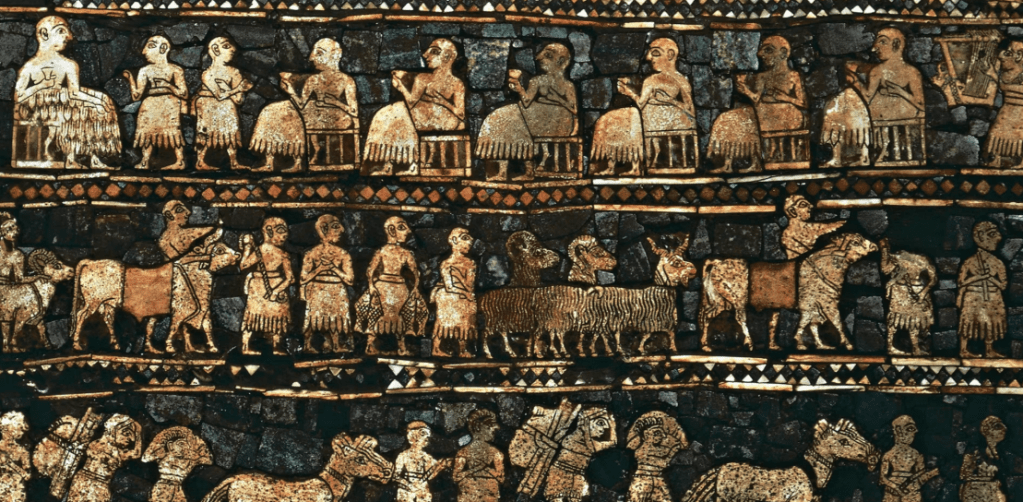
To date, Sumer is one of the oldest known human civilisations on Earth, alongside that of Ancient Egypt and the Indus Valley civilisation.
(Note: Though the ruins of Göbekli Tepe predate all of these civilisations, more research is being done to determine whether its builders can be classified as a “civilisation” rather than just a “culture”. Either way, exciting stuff!)
The name Sumer is not Sumerian itself; rather, it is what the Akkadians called it (more accurately, the Akkadians called it Šumeru).
The Sumerians referred to themselves as Saĝ-gíg | 𒊕 𒈪, or “Black Headed Ones”, called their land Kengir | 𒆠𒂗𒄀, or “The Country of the Noble Lords”, and their language Emegir | 𒅴𒂠.
The Sumerian civilisation is believed to have taken on its known form in the 4th millennium BCE, and flourished for thousands of years in the fertile lands between the Rivers Tigris and Euphrates.
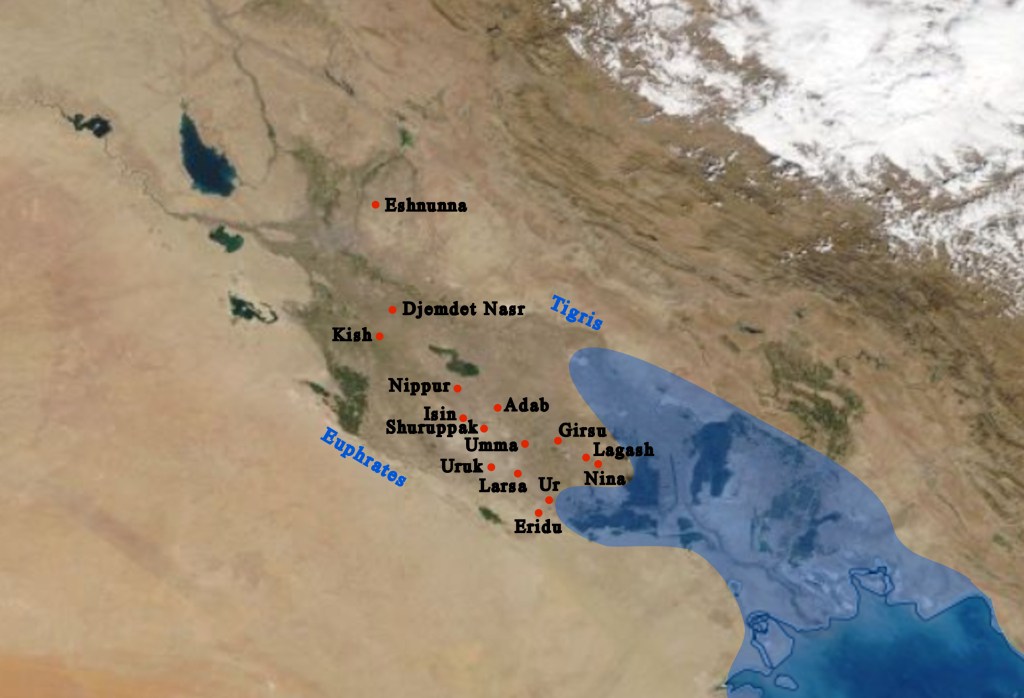
Image: A map of the main Sumerian cities and the ancient coastline. It is believed that the waters began to recede from 3000BCE, and continued to do so until 1000BCE. From Wikipedia.
The city-state Eridu is believed to have been the first major Sumerian centre to be settled, and was founded in approximately 5400BCE by the Ubaidians, a pre-Sumerian people. By 3100BCE, it is believed to have been urbanised and fully incorporated as a Sumerian settlement.
According to Sumerian tradition, Eridu was founded by the Gods, who provided humans with knowledge about kingship and civilisation. They appointed Alulim as the first King, and his legendary reign is said to have lasted as little as 28,000 years, or as much as 67,000 years, depending on which tablet you want to believe.
Despite being repeatedly conquered by the Akkadians, the Sumerian civilisation thrived until around 2000 to 1800BCE. It was then that Akkadian replaced Sumerian as the dominant culture and language in the region.
However, the Sumerian language would still be used for religious, literary, and scientific purposes up until the 1st century BCE, or around 2000 years ago. That means that at the time of this post, the Sumerian language was alive longer than it’s been dead!
Understanding Sumerian language and culture is not a strict requirement to follow Inanna, but it can be a helpful tool if you think it’ll help you to connect with Her more.
Sometimes, there’s no better way to worship a deity than how Their original people once did- even if it was thousands of years ago!
May the Goddess Inanna bless you all.
 temple of eanna | 𒂍𒀭𒈾