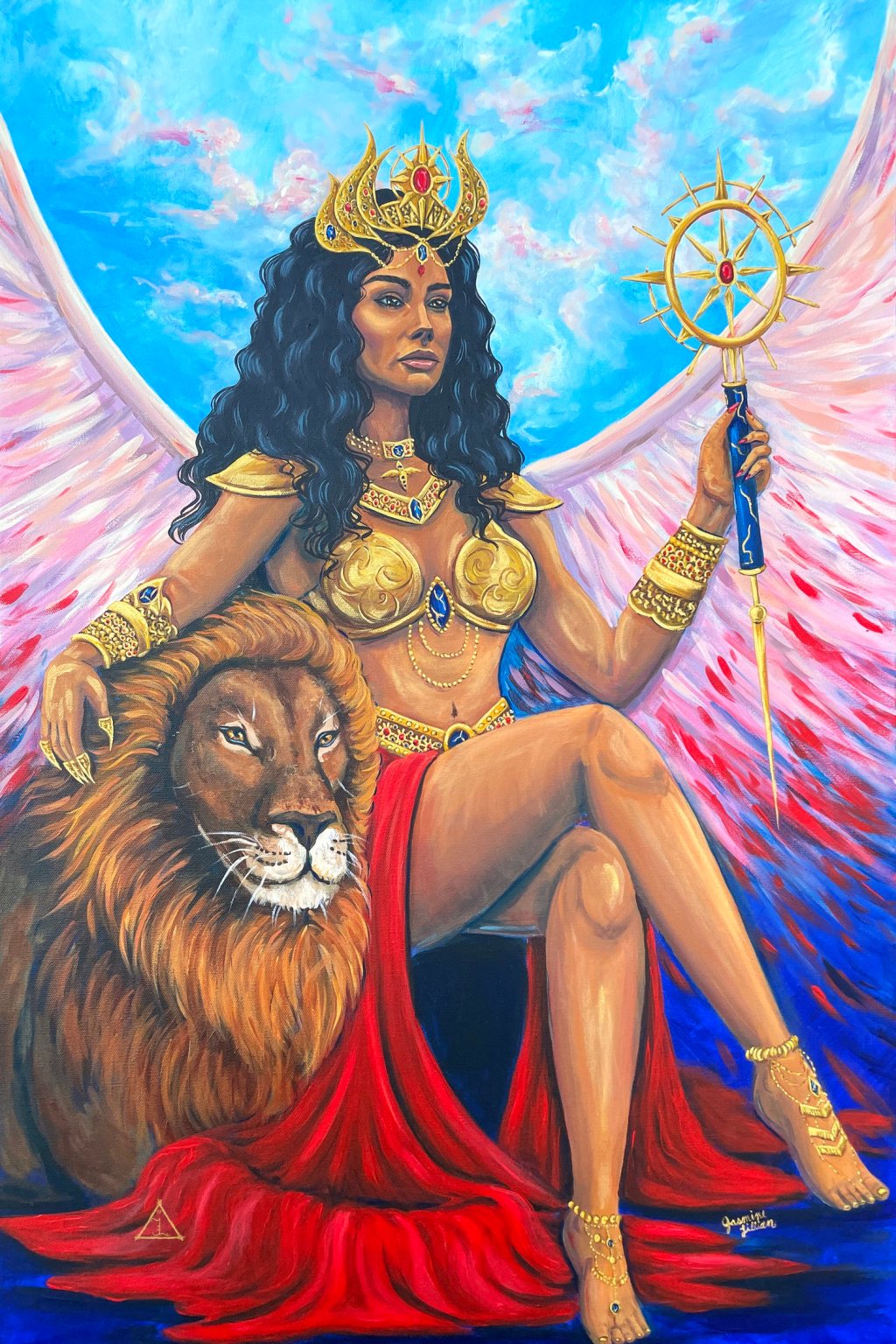
Note: This post is aimed at those wishing to engage in deity devotion. Deity work, or enlisting the help of a deity in fulfilling specific needs, is not something that I am proficient in. You can read this awesome piece by Celeste on Celestial Witchery for more information if that’s the knowledge you seek! You might find some similarities between approaching deity devotion and deity work, as they are both closely intertwined.
Image by Jasmine Lillian Buller, available here.
Introduction
In the 21st century, it is more likely than not that modern followers of Inanna will come from households where She is not recognised.
In 2020, over half of the world’s population followed one of the three major Abrahamic religions; all of which are monotheistic and strongly patriarchal. Following these three, Hinduism and Buddhism come in as the most popular non-Abrahamic religions.
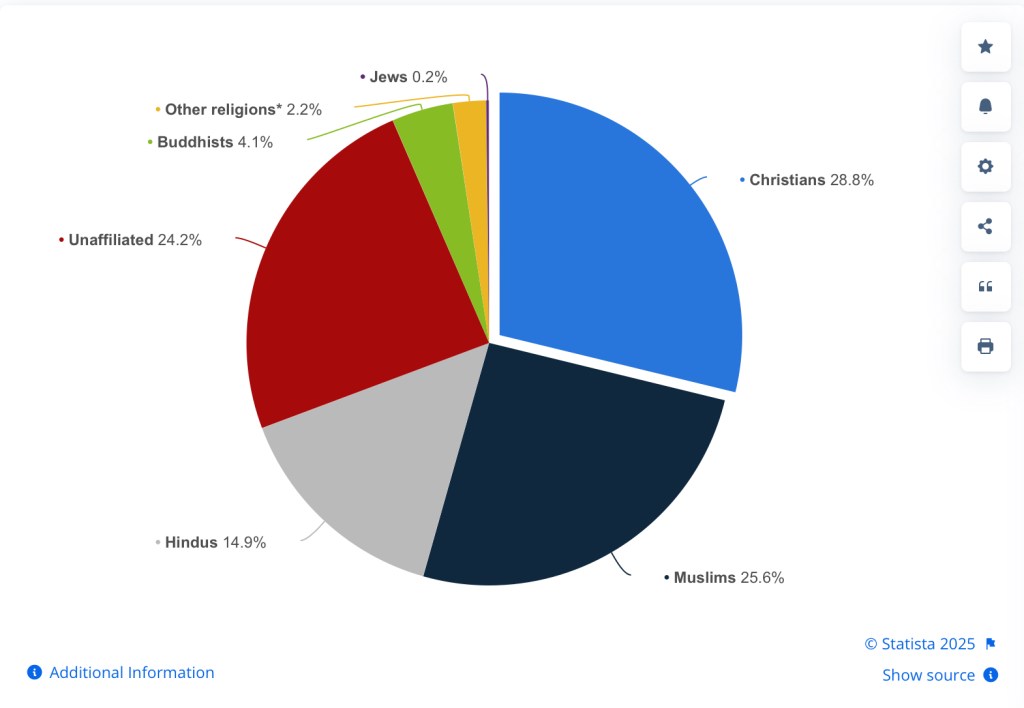
In comparison, the number of people who identified as being part of “other religions” was a mere 2.2%. This is a wide web, including faiths such as Sikhism, Shinto, and Zoroastrianism, as well as general, modern Paganism.
It is important to note that you should not feel confined to devoting yourself to only one pantheon. If you resonate with Inanna (Sumerian), but also Loki (Norse), or Athena (Hellenic), and Ptah (Kemetic), that’s fine. People in ancient times were constantly adopting foreign deities into their lives all the time—just take a look at how widespread the worship of Iset/Isis was at its peak!
For those who cannot open the link, Iset’s influence was not limited to Egypt. She was beloved by the Greeks and Romans, who in turn aided in extending Her worship to areas that they conquered. There is evidence of Her presence stretching from Roman London in the West, to Asia Minor (modern day Türkiye) in the East.
So, under the assumption that many of you are unfamiliar with Inanna or have only recently come across Her, here are three simple steps to help you build the foundation of your connection.
- Introduce yourself to Her
- Speak to Her regularly
- Establish a sacred space dedicated to Her
1. Introduce yourself to Her
If you feel put off by the idea of needing to erect an altar ASAP, that’s perfectly normal! Altars are easier to construct than they are to disassemble, so deep introspection is required before you fully commit to creating one.
The most important step in forming any sort of relationship is an introduction. You wouldn’t start a business meeting with a group of strangers without at least stating your name… right? The same thing applies for deity devotion.
Whether you choose to call it prayer or communication, both terms are okay. What is important is how you address Inanna, what you want to say to Her, and what you feel you will gain from this relationship.
Consider adding these elements into your first prayer to Inanna:
Getting Her attention — Before introducing yourself, getting Her attention is key. This can be done by lavishing Her with praise, briefly listing Her deeds, or listing Her epithets.
Here is an excerpt from the hymn “The Holy Priestess of Heaven,” from the book Inanna: Queen of Heaven and Earth, by Diane Wolkstein and Samuel Noah Kramer.
I say “Hail!” to the Holy One who appears in the Heavens!
I say “Hail!” to the Holy Priestess of Heaven!
I say “Hail!” to Inanna, Great Lady of Heaven!
Feel free to add as much as you would like in this section. It doesn’t have to be rehearsed, but if that makes it easier for you, there’s no hard rule saying you can’t practice before the real thing.
Other epithets associated with Inanna include: Lady of Uruk, Lady of Warriorship, or Lady of the me. You could also reference some of Her mythology as an epithet, such as Destroyer of Mountains (Her destruction of Mount Ebih), Purveyor of Justice (such as when she punishes Shukaletuda for defiling Her), or even Daughter of the Moon (since She is the daughter of Nanna).
Introducing yourself — Once you’ve gotten Her attention, now is the time to introduce who you are and why you are reaching out to Her. How you do this is totally your choice, but here’s the framework I followed in my own introduction:
- Stating my name — Because at that time, I was a complete stranger to Her.
- Stating my intention — I was transparent with my intent, and made it known that there were still lingering doubts about following Her. I felt drawn to the idea of devoting myself to Her, but there was still some religious trauma preventing me from reaching the level of complete confidence in Her. It is okay to acknowledge if you are not 100% ready for this journey; what matters is that you are honest and prepared to do the work necessary to reach that 100%.
- Stating what I could offer — Despite what some may think, Gods are not our friends. Yes, you can totally be friendly with them, but it is important to bear in mind the power dynamics of the relationship. They are entities who are greater than us; as much as we can choose which deities to approach, they can also choose to disengage with us. We must always be respectful. Humans have their own kind of divinity, but it should never be used to challenge that of a God or Goddess.
- Reiterating my intention — You don’t have to completely repeat what you said, a line or two to signal that you are nearing the end of your prayer will suffice.
- Stating my thanks — I thanked Inanna for taking the time to hear my voice, and used the opportunity to express my heartfelt gratitude.
2. Speak to Her regularly
Once you have established your first connection with Inanna, it is time to build on it. How often you choose to communicate with Her is up to you; it can be as often as three times a day, or as little as once a day. The frequency is not as important as the consistency.
There are no set rules as to how long you must spend creating the bridge between yourself and Inanna; I personally started out by praying once a day for a few weeks straight—a big feat for me, since I was not typically a person who prayed so often lol.
Your prayers don’t have to be super long. They can just be a brief session of praise and thanks, even if it’s only for a couple of minutes. Personally, I felt that the initial regular prayer helped paint a picture of who I was for Her, and filled in a lot of background knowledge about myself.
Some days I would mention good things that happened to me, and thank Her for it. Other days, I would complain about my (nonexistent) love life and ask for some tips.
Nowadays I don’t pray as much as in the beginning, but the connection remains strong because prayers are no longer my only form of communication.
I meditate, I light candles and incense, I pull out my tarot deck, I offer food and drink, I recite hymns, I sing and dance. Actual prayers are done only 1–2 times a week, and that’s also fine. Everyone connects with Inanna in their own, unique way.
How you choose to keep in contact with Inanna is all up to you! Follow what feels right 🙂
3. Establish a sacred space dedicated to Her
Finally, the big pièce de résistance of Paganism: creating a shrine!
Important note: You should not erect a shrine if it will somehow endanger your safety; i.e., if you live with your strictly monotheistic parents or live in a place where open displays of spirituality are punishable. Your mental and physical wellbeing is more important.
First, you should choose a space in your home that is spacious, free of clutter, and easy to clean. This could be a shelf, bedside table, or even a free spot on your desk.
Second, cleansing the space and officially recognising its purpose as a shrine is important. How you choose to do this is also up to you, as there are many methods available. Here are some helpful resources:
✴️ How to Cleanse Your Space by Hana O’Neill
✴️ Why You’re Cleansing Your Home All Wrong (and What to Do Instead) by Julia Cancilla
✴️ Cleansing Without Sage by Good Witch Kitchen
Once you have consecrated this space, avoid using it for other purposes, or placing unrelated items on it.
Third, the fun part—how do you envision your shrine to be? As a beginner, you don’t need to fill your shopping cart with all sorts of statues, crystals, and incense sticks just yet (unless that’s something you’re financially capable of!).
A shrine can be as simple as having two things: an representation of Inanna, and a candle. If you have these bare essentials, you can easily add more as you become more experienced. The representation can be an image you printed out, an artwork your bought, or a sculpture if that’s within your budget.
Since this is a beginner guide, I won’t go too much into what else to put on your shrine—that’s another post altogether!
Other ways to show your dedication to Inanna
For those who are unable to dedicate a shrine to Inanna, there are many other ways of expressing your devotion.
- Prayer — The most important part of keeping your connection with Inanna is communication, and prayer is the easiest way. Your prayer doesn’t need to be said aloud; you can pray in silence. Your intention is the most vital component.
- Meditation — Self-reflection and finding inner peace as a means to ground yourself, especially in preparation of prayer, is another easy way.
- Journalling — If you prefer writing, noting down your thoughts and wishes is another method. You could also journal your own poetry and hymns dedicated to Inanna, if you feel so inclined.
- Reading Her myths — Whether online or through a physical book, reading more about the core myth’s of Inanna’s character is a great way to gain deeper understanding of the Goddess.
- Thinking about Her — Even the act of simply thinking about Inanna, whether it’s daydreaming at work or lying in bed at night, is another way of expressing your devotion.
- Wearing jewellery with Her iconography — This one is a bit more on the nose, but for anyone who is able to pass off jewellery that represents Inanna as “fashion”, it’s another way of being able to express your dedication to Inanna. It doesn’t even have to have Her iconography. You can choose jewellery made of materials sacred to Inanna, such as lapis lazuli, gold, and carnelian. My absolute favourite deity jewellery shop is Hecate’s Boutique on Etsy. Their work is stunning!

Last edited: August 12, 2025
Further reading
Alvar, J. (2022, March 28). Worship of this Egyptian goddess spread from Egypt to England. National Geographic. https://www.nationalgeographic.com/history/history-magazine/article/isis-egyptian-goddess-worship-spread-egypt-england#:~:text=Archaeologists%20working%20in%20London%20in,dawn%20of%20ancient%20Egyptian%20history.
Cancilla, J. (2024, October 12). Why You’re Cleansing Your Home All Wrong (and What to Do Instead). Elle Decor. https://www.elledecor.com/life-culture/cleaning-organizing/a62558522/how-to-cleanse-energy-home/
Cleansing Without Sage. (2019, December 10). Good Witch Kitchen. https://www.goodwitchkitchen.net/cleansing-without-sage/
Deity Work 101. (2025, July 21). Celestial Witchery. https://celestialwitchery.com/deity-work-101/
O’Neill, H. (n.d.). How to cleanse your space. Suburban Witchery. https://www.suburbanwitchery.com/blog/how-to-cleanse-and-clear-your-space?srsltid=AfmBOopmsYOiNXILDrxftcV5IjakgF8qOT0nl6ibMf3FtiArySYhDTZf
So how did the worship of Isis spread throughout the ancient world? (2014, June 10). Isiopolis. https://isiopolis.com/2014/06/08/so-how-did-the-worship-of-isis-spread-in-the-ancient-world/
Wolkstein, D., & Kramer, S. N. (1983). Inanna, queen of heaven and earth.
 temple of eanna | 𒂍𒀭𒈾
Leave a comment