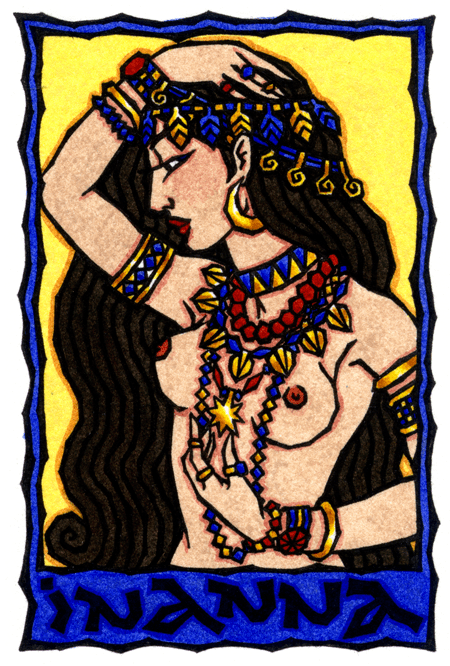
Main image: “Inanna” by Thalia Took.
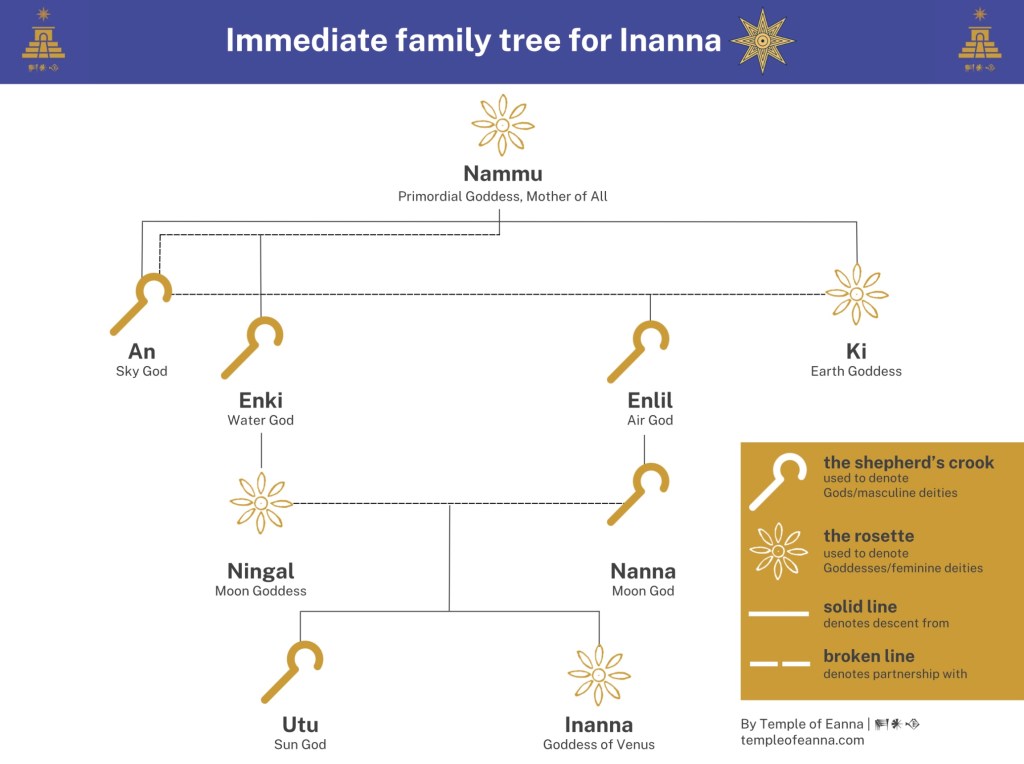
To understand Inanna, we must first understand Her role in the Sumerian pantheon. Here is a visual depiction of Her immediate family tree.
Family History
Nammu
At the top of the family tree is the Great Mother Goddess, Nammu. She is portrayed as a benevolent, nurturing Goddess who rose from the primordial waters and birthed the first generation of Gods: An and Ki.
Nammu was not widely worshipped in Sumer, but was still mentioned in texts, hymns, and inscriptions for her vital role as the Creatrix of All. Unlike Her later Babylonian counterpart, Tiamat, Nammu is not known to have shown any form of aggression or violence, especially against other deities.
This juxtaposition also draws parallels between Inanna and Her Semitic counterpart, Ishtar; read more about their differences here.
An & Ki
The God of the sky, An, is considered the king of all the Gods, with the Goddess of the earth, Ki, as His consort. In the beginning, They are believed to have been intertwined, leaving little space in between.
Their union would eventually lead to Enlil’s birth; Enlil would then go on to separate His parents, creating the space in between needed for life to flourish.
An would be pushed upwards, becoming the sky, while Ki would be left below, becoming the earth. Enlil would procreate with Ki, leading to the creation of the plants and animals on earth.
(Note: This is similar to the Māori myth of Papatūānuku and Ranginui—click here to read more about it!)
Like Nammu, An and Ki were not actively worshipped in Sumer, but played significant roles in the pantheon nonetheless.
Although this family tree notes An and Nammu as being the parents of Enki, the God of fresh water, creation, and wisdom, in earlier Sumerian texts it is believed that Nammu gave birth to Enki by Her own volition.
Enlil
The God of wind, air, and storms, Enlil is considered the chief deity of the Sumerian pantheon. He is also infamously known as the God who sent the Great Flood to wipe out humanity after They grew too noisy and disturbed His rest.
He was the patron God of Nippur, where His centre of worship, Ekur | 𒂍𒆳, (House of the Mountain) was located. His consort is the Goddess Ninlil (not shown in the family tree), and together They had several children- one of whom is Inanna’s father, Nanna.
Personality-wise, Enlil can be described as stern, harsh, and always gets His way, regardless of who must be trampled in order to achieve His goals.
An example of this can be seen in the myth Enlil and Ninlil, where Enlil spots the Goddess Ninlil bathing in a river and lusts for Her. Ninlil is unmarried and has not experienced sexual intercourse, so She protests against His advances.
Yet, Enlil still forces himself on Ninlil and unconsensually impregnates Her with the God of the moon, Nanna. For His transgression, Enlil is banished from Nippur and sent to the Underworld.
Enki
The God of fresh water, creation, and wisdom, Enki is usually considered to be Enlil’s junior in terms of birth order. While some myths have Nammu as His mother and An as His father, in earlier versions of Sumerian myths it was believed that Enki’s only parent was Nammu.
Enki was the patron God of Eridu, where His centre of worship, Eabzu | 𒂍𒍪𒀊 (House of the Aquifier) was located. His primary consort was the Goddess Damgalnuna, but He is known to have relationships with other Goddesses.
In particular, from His union with the Goddess of reeds Ningikuga (not shown in the family tree), He would father the Goddess Ningal, who is Inanna’s mother.
Enki is shown to be the more compassionate and sympathetic out of Himself and Enlil. When Enlil announces that He will send the Great Flood, Enki warns a man named Ziusudra and advises him to build a large boat in order to survive the deluge.
It is also Enki who heeds Ninshubur’s pleas to help Inanna in the Underworld, after Enlil and Nanna both refused.
Nanna & Ningal
Nanna is the Sumerian God of the moon, and His wife is Ningal. Their primary city of worship was Ur, though like all other deities They were worshipped across the Sumerian city-states.
Nanna’s cult centre was the Ekishnugal | 𒂍𒄑𒋢𒃲 (House of the Great Light), most famously known for its well-preserved and reconstructed ziggurat. One of His High Priestesses, Enheduanna, is renowned for being the first recorded author in human history to date. Enheduanna’s works also included hymns to Inanna, with whom she shared an affinity with.
As for Ningal, Her temple in Ur was likely Egarku | 𒂍𒄈𒆪 (House of the Pure Foundation). In addition to being an astral deity (considering Her marriage to the Moon God and being the mother of the God of the sun and Goddess of Venus), Ningal was also worshipped as a Goddess of fertility and reeds. As reeds were used in everyday life in Mesopotamia, from boat-making to writing and weaving, this would have been an integral role.
Utu
Utu is the Sumerian God of the sun, and is considered Inanna’s twin brother. He does not appear as the main character in any known Sumerian myths, but He has featured in a few, ranging from The Courtship of Inanna and Dumuzid– where He tries to convince Inanna to marry Dumuzid- to the Epic of Gilgamesh, where He helps Gilgamesh and Enkidu defeat Humbaba.
Utu’s consort is the Goddess of dawn and light, Sherida, and His main centres of worship were Larsa and Sippur. In both cities, the temples dedicated to Him and His wife were both called Ebabbar | 𒂍𒊩𒌆 (Shining House).
The Anunna Gods
Finally, Inanna’s family tree cannot be discussed without mentioning the Anunna Gods, more popularly known in pop culture as the Anunnaki. In earlier Sumerian mythology, the term Anunnaki was applied to the most powerful Gods and Goddesses in the pantheon.
The exact number of Anunnaki is uncertain, and varies in Sumerian texts. In Inanna’s Descent to the Underworld, the Anunna are described as the “seven judges,” or the “seven Gods who decree fate.”
The Anunna could also refer to the pantheon of each city-state, such as the Anunna of Eridu, or the Anunna of Lagash. In one text, the “fifty Anunna of Eridu” are mentioned, but not explicitly named.
Another definition of the Anunna Gods limits it to the descendants of An and Ki; in the family tree above, this would make the Anunnaki Gods An, Ki, Enlil, Enki, Nanna, Utu, and Inanna.
In some cases, the Goddess Ninhursag is also considered an Anunna God in place of Ki; though some historians claim that Ninhursag and Ki were originally the same Goddess.
Last updated: August 10, 2025
Sources
- Chavalas, M. (Ed.). (2013). Women in the Ancient Near East: A Sourcebook (1st ed.). Routledge.
- Ekišnugal, sanctuary of the god Nanna/Sin. (2022, June 24). https://www.college-de-france.fr/en/agenda/lecture/the-city-of-ur-in-paleo-babylonian-times/ekisnugal-sanctuary-of-the-god-nannasin
- German, S. (n.d.). SmartHistory – Ziggurat of UR. https://smarthistory.org/ziggurat-of-ur/
- O’Brien, J. (1983). Nammu, Mami, Eve and Pandora: “What’s in a Name?” The Classical Journal, 79(1), 35–45. http://www.jstor.org/stable/3297042
- Wolkstein, D., & Kramer, S. N. (1983). Inanna, queen of heaven and earth.
 temple of eanna | 𒂍𒀭𒈾
Leave a comment